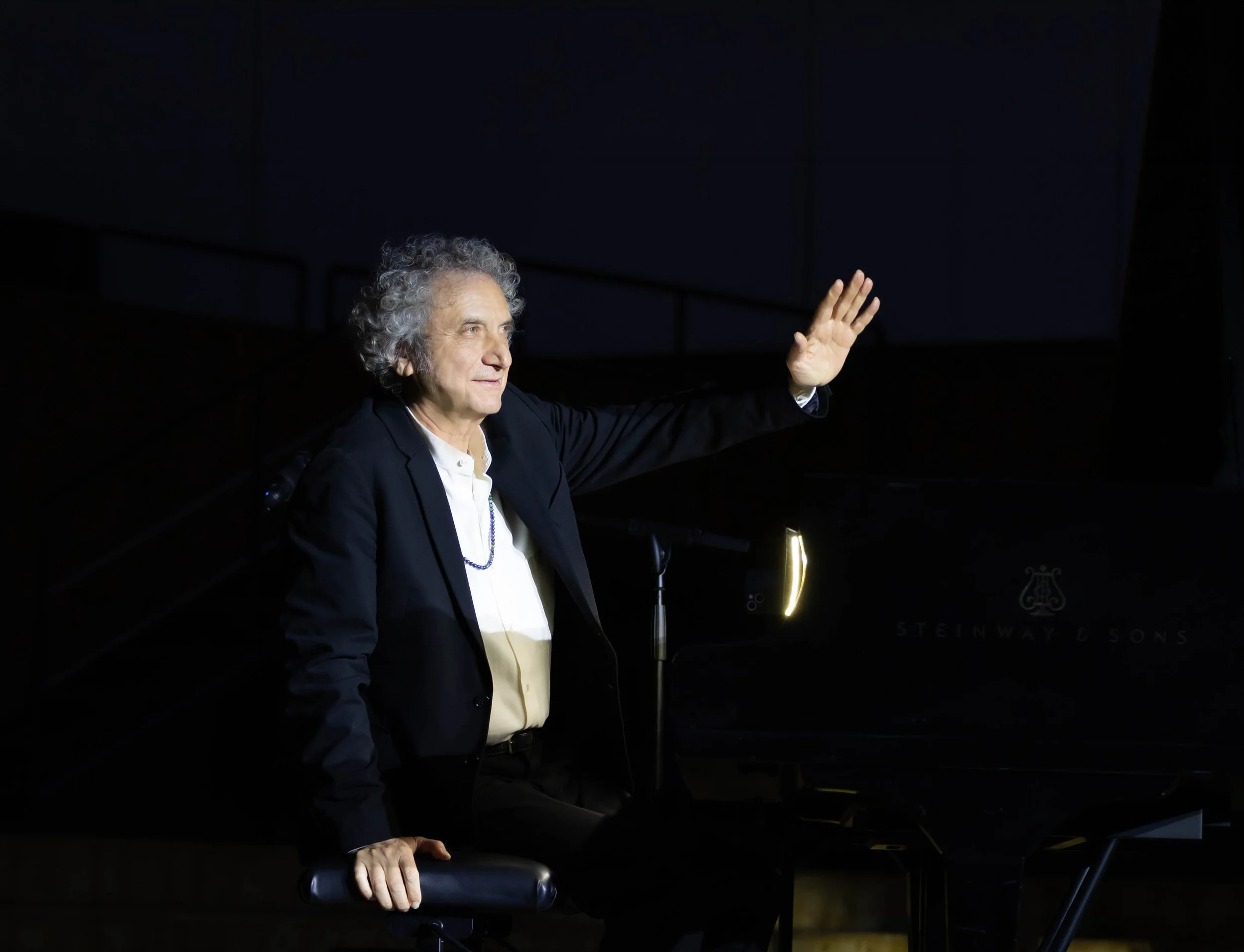
Roberto Cacciapaglia is among the most innovative composers and pianists on the international music scene. His music brings together classical composition and electronic experimentation, tradition and modernity, in a continuous search for the essence that unites languages beyond any distinction of genre. His work explores the primordial power of sound – melody, harmony, vibration – as a force capable of generating emotion, awareness, and spiritual communion.
Born in Milan, he graduated in composition under Bruno Bettinelli at the Conservatorio Giuseppe Verdi, where he also studied electronic music and conductorship. During those years, he worked at the RAI Phonology Studio and collaborated with the CNR in Pisa, exploring the early applications of computers in music.
In 1976, he released “Sonanze” (Ohr) – the first quadraphonic LP ever produced in Italy – marking the beginning of a journey that would unite acoustic and electronic sound. This was followed by works such as “Sei note in Logica” (Philips, 1978) for voices, orchestra, and computer, and “Generazioni del Cielo” (1986), a two-act opera premiered at the Teatro Metastasio in Prato and the Teatro Dal Verme in Milan.
In the same years, he presented “Lamentazioni di Geremia” (1988) at the International Festival of Tel Aviv, performed “In C” with Terry Riley and his “Transarmonica” at the Aterforum in Ferrara, and composed “Aurea Carmina”, based on a text by Pythagoras, commissioned by the Accademia Nazionale di Santa Cecilia. Other works from this period include “Il segreto dell’Alba” (Teatro Comunale di Bologna, 1989), “Un Giorno X” (1990, Milan Conservatory), and “Le Mille e una Notte” (1991), a musical fairy tale staged at the Berliner Festspiele, the Mariinsky Theatre in St. Petersburg, and the Spoleto Festival.
In the following years, his research expanded into new forms of expression, where orchestra, voice, and technology blend into a single sonic space. Alongside his work in theatre and international festivals, he collaborated with poets, scientists, and artists from various disciplines, exploring the link between sound and thought, matter and spirit. Within this context, he also took part in “La Milanesiana,” conceived by Elisabetta Sgarbi, presenting projects such as “La Dissoluzione dell’Aria” (2003) with Nobel Prize – winning poet Derek Walcott, and “Mente Radiosa” (2005) with Nobel laureate in Medicine Rita Levi-Montalcini.
His artistic partnership with the Royal Philharmonic Orchestra of London gave rise to works such as “Quarto Tempo” (2007), “Canone degli Spazi” (2009), and “Ten Directions” (2010), where symphonic breadth opens toward a meditative and visionary dimension.
In the same year, he performed with the Dubai Philharmonic at the opening ceremony of Ferrari World in Abu Dhabi.
In 2013 he composed “Antartica” for the European Concordia expedition in Antarctica (European Space Agency), followed by “Alphabet” (Decca). The following year he created “Tree of Life” (Believe), the official soundtrack of the Albero della Vita, symbol of Expo Milano 2015, performed with the Orchestra of the Accademia Teatro alla Scala during the closing ceremony.
Sensitive to environmental issues, he took part in the 2017 Earth Day celebrations in Rome and the G7 Environment Summit in Bologna. The following year, he embarked on the Celebration Tour, which travelled through Russia, Europe, China, Turkey, and the United States, culminating in a concert at Carnegie Hall in New York – awarded “Best Live Act 2019” by Bluebird Reviews. Around the same time, he recorded “Diapason” with the Royal Philharmonic Orchestra at Abbey Road Studios in London, later presented on the Diapason Worldwide Tour.
Among his cross-disciplinary collaborations, fashion designer Stella McCartney chose his piece “Sparkling World” for her 2018 Spring/Summer campaign. During the 2020 pandemic, he composed “Days of Experience”, dedicated to the collective experience of that time, presented in concert at Teatro Bibiena in Mantua. In 2021 he released “Angel Falls” (Believe) and performed two solo piano concerts at the Milan Conservatory and London’s Cadogan Hall, home of the Royal Philharmonic Orchestra.
His music has also accompanied the triumphs of Italy’s national rhythmic gymnastics team, the Farfalle Azzurre, who won Olympic gold performing to “Wild Side – Tree of Life Suite” (Tokyo 2020 and the 2021 World Championships in Kitakyushu).
Always committed to nurturing the new generations, he founded in 2012 the Educational Music Academy, created to offer young musicians a place for growth and experimentation.
In 2023 he received the Premio Montale and, the following year, appeared on BBC Four in the UK, returning in concert at Cadogan Hall. In 2024 he performed at the Queen’s Hall in Edinburgh for the world premiere of “Incipit / Moz-Art K.488 ReComposed” and presented “Borderlands”, the third single previewing the album “Time to Be” (November 28, 2024). The piece premiered at the Scottish Parliament during the Festival of Politics and in Italy at the Sale Apollinee of Teatro La Fenice in Venice.
In 2024, “Time To Be” (Virgin Music Group) was released, reaching the top of the iTunes Classical charts in the United Kingdom, Italy, and China. The project marked a pivotal moment in his artistic journey: a sonic voyage toward a new dimension of awareness, an invitation to be music rather than merely make it.
Presented live in the spring of 2025 with the “Time To Be Tour”, which brought his music to some of Italy’s most prestigious theatres, the album reaffirmed Cacciapaglia’s vision of a musical language that unites emotion and introspection.
In September of the same year, he performed in Tokyo for the Bvlgari Kaleidos – Colors, Cultures and Crafts exhibition at the National Art Center, and, in October, he appeared in concert in Gorizia to celebrate Gorizia and Nova Gorica as the European Capital of Culture 2025.
In February 2026, Cacciapaglia composed and conducted the music for the Finale and Grand Finale of the Milano Cortina 2026 Winter Olympics, as well as for the daily music-and-light show at Arco della Pace, attended each evening by thousands of locals and visitors. He later released the EP “Olympia”, featuring the four symphonic movements created for the occasion.
In the spring of 2026, he toured some of Italy’s major concert halls and theatres with his AURAL tour, which received strong public acclaim, standing ovations, and sold-out performances.
Roberto Cacciapaglia è tra i compositori e pianisti più innovativi della scena musicale internazionale. Nella sua musica convivono scrittura classica e sperimentazione elettronica, tradizione e contemporaneità, in una ricerca continua dell’essenza che unisce i linguaggi oltre ogni distinzione di genere. Il suo lavoro indaga il potere primordiale del suono – melodia, armonia, vibrazione – come forza capace di generare emozione, consapevolezza e comunione spirituale.
Nato a Milano, si diploma in composizione con Bruno Bettinelli presso il Conservatorio “Giuseppe Verdi”, dove studia anche musica elettronica e direzione d’orchestra. In quegli anni lavora allo Studio di Fonologia della Rai e collabora con il CNR di Pisa, approfondendo le prime applicazioni del computer in campo musicale.
Nel 1976 pubblica “Sonanze” (Ohr), primo LP quadrifonico realizzato in Italia, che segna l’inizio di un percorso destinato a fondere l’acustico e l’elettronico. Seguono lavori come “Sei note in Logica” (Philips, 1978) per voci, orchestra e computer, e “Generazioni del Cielo” (1986), opera in due atti rappresentata al Teatro Metastasio di Prato e al Teatro Dal Verme di Milano.
Negli stessi anni presenta “Lamentazioni di Geremia” (1988) al Festival Internazionale di Tel Aviv, esegue “In C” con Terry Riley e il suo “Transarmonica” all’Aterforum di Ferrara, e compone “Aurea Carmina”, su testo di Pitagora, commissionata dall’Accademia Nazionale di Santa Cecilia. Seguono “Il segreto dell’Alba” (Teatro Comunale di Bologna, 1989), “Un Giorno X” (1990, Conservatorio di Milano) e “Le Mille e una Notte” (1991), fiaba musicale rappresentata al Berliner Festspiele, al Teatro Mariinskij di San Pietroburgo e al Festival di Spoleto.
Negli anni successivi la sua ricerca si apre a nuove forme di linguaggio, in cui orchestra, voce e tecnologia si fondono in un unico spazio sonoro. Parallelamente al lavoro in teatro e nei festival internazionali, collabora con poeti, scienziati e artisti di diverse discipline, esplorando il legame tra suono e pensiero, materia e spirito. In questo ambito, partecipa anche a “La Milanesiana” ideata da Elisabetta Sgarbi, dove presenta progetti come “La Dissoluzione dell’Aria” (2003) con Derek Walcott, Premio Nobel per la Letteratura, e “Mente Radiosa” (2005) con Rita Levi-Montalcini, Premio Nobel per la Medicina.
Con la Royal Philharmonic Orchestra di Londra avvia un sodalizio artistico che darà vita a lavori come “Quarto Tempo” (2007), “Canone degli Spazi” (2009) e “Ten Directions” (2010), nei quali l’ampiezza sinfonica si apre a una dimensione meditativa e visionaria. Nello stesso anno (2010) si è esibito in concerto con la UAE Philharmonic Orchestra in occasione della cerimonia di apertura del Ferrari World di Abu Dhabi.
Nel 2013 compone “Antartica” per la spedizione europea Concordia in Antartico (European Space Agency), seguito da “Alphabet” (Decca, 2014), registrato nella Sala Verdi del Conservatorio di Milano. L’anno successivo realizza “Tree of Life” (Believe), colonna sonora ufficiale dell’Albero della Vita, simbolo di Expo Milano 2015, eseguita con l’Orchestra dell’Accademia Teatro alla Scala durante la cerimonia di chiusura.
Sensibile ai temi ambientali, partecipa nel 2017 agli eventi di Earth Day a Roma e al G7 Ambiente di Bologna. L’anno successivo intraprende il “Celebration Tour”, che tocca Russia, Europa, Cina, Turchia e Stati Uniti, culminando nel concerto alla Carnegie Hall di New York, premiato da Bluebird Reviews come “Best Live Act 2019”. Nello stesso periodo registra “Diapason” con la Royal Philharmonic Orchestra presso gli Abbey Road Studios di Londra, poi presentato nel Diapason Worldwide Tour.
Tra le collaborazioni trasversali, la stilista Stella McCartney sceglie il suo brano “Sparkling World” per la campagna della collezione Primavera/Estate 2018. Durante la pandemia del 2020 compone “Days of Experience”, dedicato al vissuto collettivo di quel periodo e presentato con un concerto al Teatro Bibiena di Mantova. Nel 2021 pubblica “Angel Falls” (Believe) e si esibisce in due concerti per pianoforte solo al Conservatorio di Milano e alla Cadogan Hall di Londra, residenza della Royal Philharmonic Orchestra.
Le sue musiche accompagnano anche le vittorie della squadra nazionale italiana di ginnastica ritmica, le Farfalle Azzurre, oro olimpico su “Wild Side – Tree of Life Suite” (Tokyo 2020 e Mondiali di Kitakyushu 2021).
Da sempre attento alla formazione delle nuove generazioni, fonda nel 2012 la Educational Music Academy, nata per offrire ai giovani musicisti un luogo di crescita e sperimentazione.
Il 24 febbraio 2023 pubblica l’album “Invisible Rainbows” (Ingrooves) che esce in vinile e CD in UK e USA il 21 marzo. Il progetto discografico, realizzato in Dolby Atmos e registrato con I Virtuosi Italiani, è anticipato da tre singoli che raggiungono la vetta delle classifiche UK, Italia e Cina: “Atlantis”, “London Sleeps” e “Rainbows”.
Nel 2023 riceve il Premio Montale e, l’anno successivo, è ospite di BBC Four in Inghilterra, tornando in concerto alla Cadogan Hall. Nel 2024 si esibisce alla Queen’s Hall di Edimburgo per la prima mondiale di “Incipit / Moz-Art K.488 ReComposed” e presenta “Borderlands”, terzo singolo che anticipa l’album “Time to Be” (28 novembre 2024). Il brano è eseguito in prima assoluta al Parlamento scozzese per il Festival of Politics e in Italia nelle Sale Apollinee del Teatro La Fenice di Venezia.
Nel 2024 esce l’album “Time To Be” (Virgin Music Group), subito ai vertici delle classifiche iTunes Classic nel Regno Unito, in Italia e in Cina. Il progetto segna una tappa centrale nel suo percorso artistico: un viaggio sonoro verso una nuova dimensione di consapevolezza, un invito a essere musica più che a farla.
Presentato dal vivo nella primavera del 2025 con il Time To Be Tour, che ha toccato i più prestigiosi teatri italiani, l’album consolida la visione di un linguaggio musicale capace di unire emozione e introspezione.
Nel settembre dello stesso anno si esibisce a Tokyo, in occasione della mostra Bvlgari Kaleidos – Colors, Cultures and Crafts al National Art Center, mentre a ottobre è in concerto a Gorizia per celebrare con la sua musica Gorizia e Nova Gorica Capitale Europea della Cultura 2025.
Nel febbraio 2026, compone e dirige la musica per il Finale e Gran Finale della cerimonia di apertura delle Olimpiadi Invernali Milano Cortina 2026, e dello spettacolo quotidiano all'Arco della Pace, visto ogni sera da migliaia di persone.
Nella primavera del 2026 ha portato il suo tour AURAL in alcuni tra i principali teatri e sale da concerto italiane, ottenendo un grande successo di pubblico, standing ovation e date sold out.